
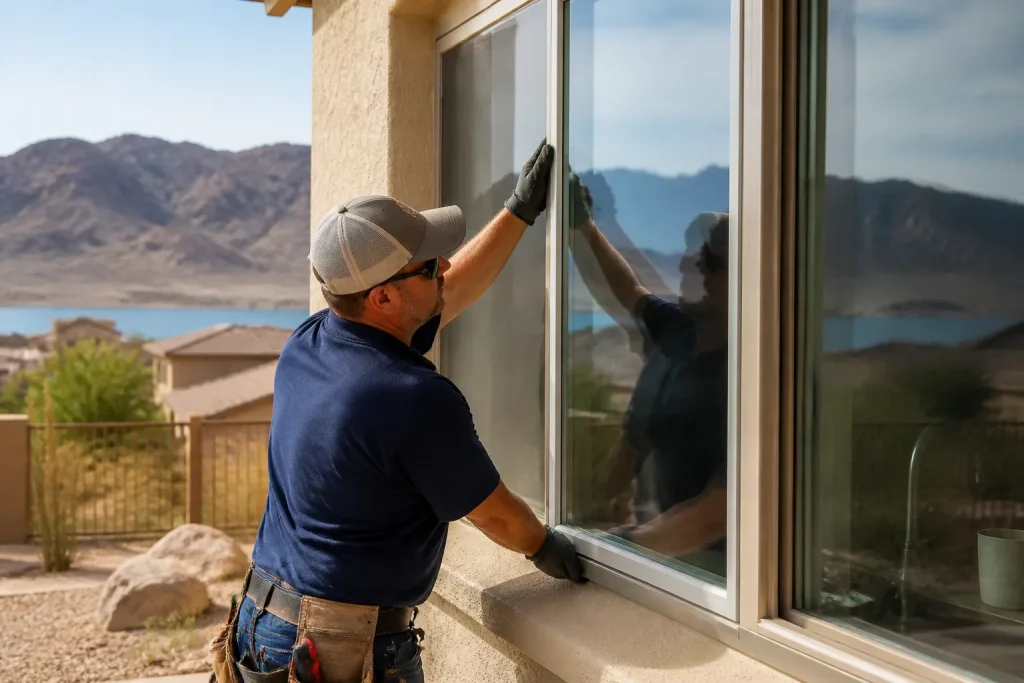
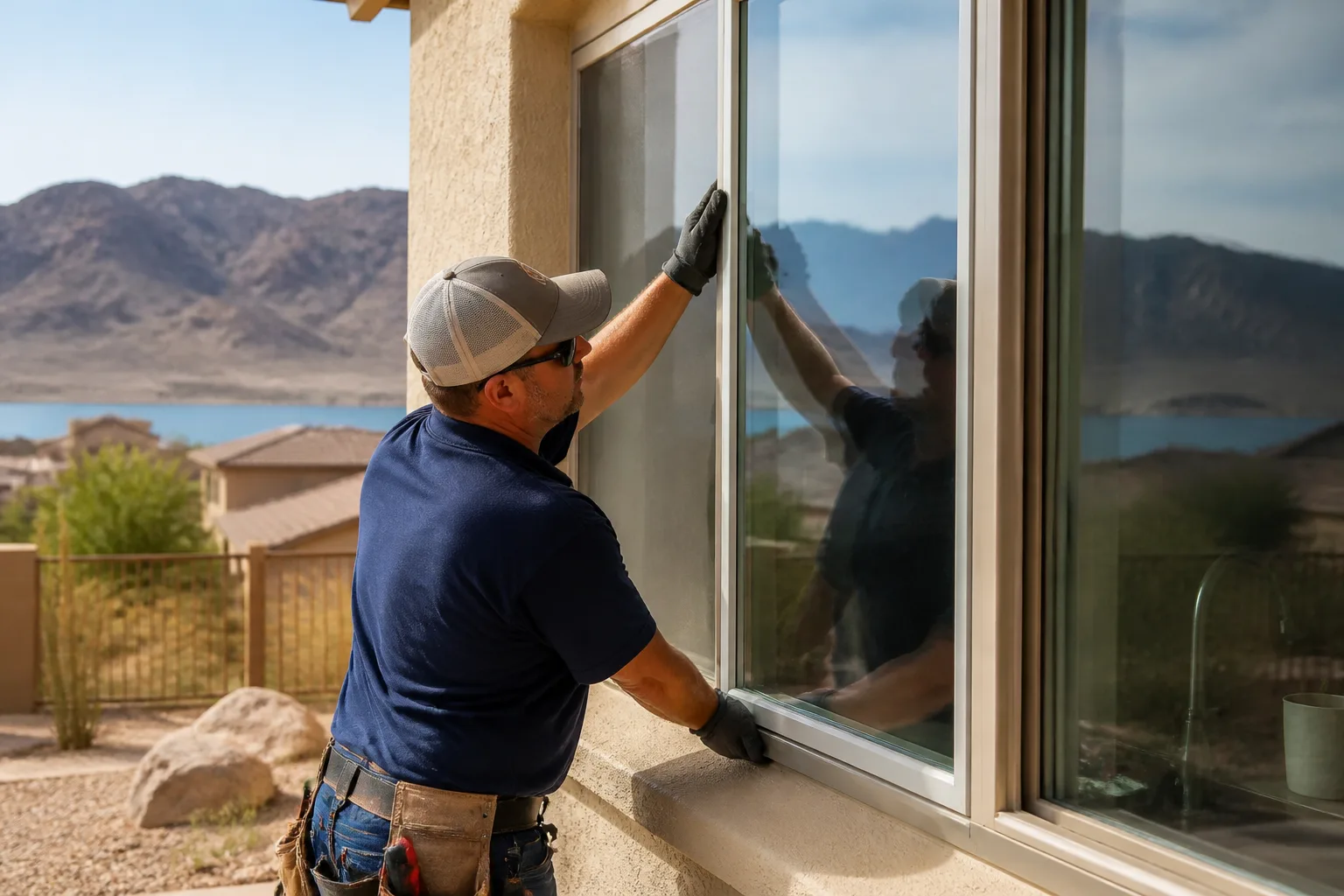
5 Mistakes to Avoid With Window Replacement
Specifying a standard low-E glass package on a west-facing Boulder City window is one of the most common and costly mistakes in local residential replacement. The wrong low-E coating position increases solar heat gain instead of reducing it, and the difference shows up on your very next utility bill. The five checkpoints below are what separate a replacement that performs for twenty years from one that fails at year four. If you’d rather not sort through glass specs and sill conditions yourself, call (833) 847-4018 and we’ll walk you through it.
Key Takeaways
- Measure the rough opening, not the existing frame; desert heat shifts old frames and a 1/8- to 1/4-inch error ruins the fit.
- South and west exposures in Boulder City need low-E coating on the #3 surface, not #2.
- Expanding foam is a secondary seal; using it as the primary air barrier cracks the bond in summer heat.
- Check the sill for rot and moisture before the new unit goes in, every time.
- Photograph the opening before drywall patching; it’s the only evidence you’ll have if a warranty claim surfaces 18 months later.
Mistake 1: Measuring to the Existing Frame Instead of the Rough Opening
The most expensive error in window replacement isn’t the glass, it’s the tape measure. We routinely find installers measuring to the face of the old frame because it’s faster and the number looks right. In Boulder City, that number is usually wrong. Old wood and vinyl frames shrink and shift in this climate – the same 110-degree summers and single-digit winter nights that make the desert beautiful also move wood fibers and stress vinyl welds. A frame that measured 36 inches square in 2008 can read 35-7/8 by 35-3/4 today.
That 1/8- to 1/4-inch error compounds. The new unit goes in slightly undersized, the installer fills the gap with more sealant than the assembly was designed for, and the whole window now depends on caulk instead of a mechanical fit. You won’t notice the first year. You’ll notice the draft in year three.
The fix is procedural, not experiential: strip the trim, measure the rough opening at three points (top, middle, bottom for width; left, center, right for height), and record the smallest dimension. That’s the number the order gets cut to. Anything less is a guess dressed up as a measurement.
Mistake 2: Specifying the Wrong Low-E Coating Position for South and West Exposures
Here’s the part almost no homeowner gets told. Low-E glass isn’t one product. It’s a microscopic metallic coating applied to one specific surface of the insulated glass unit, and the surface matters as much as the coating.
Every double-pane unit has four surfaces, numbered from the outside in:
- Surface #1 – outer face of the exterior pane.
- Surface #2 – inner face of the exterior pane.
- Surface #3 – outer face of the interior pane.
- Surface #4 – inner face of the interior pane.
In a cooling-dominant climate like Boulder City’s, you want the coating on surface #3. That placement reflects solar heat back out before it conducts through the air gap, and it protects the coating from the weather. Put the same coating on surface #2 and you get a unit that traps heat between the panes – the SHGC (solar heat gain coefficient) climbs, the utility bill climbs with it, and the glass still looks identical from the curb. On the west wall of a Boulder City house, that mistake can add real money to a summer power bill.
When we specify glass from lines like ES Windows or ECO Window Systems, the surface position is written on the order. Ask to see it.
Mistake 3: Treating Expanding Foam as a Primary Air Seal
Expanding foam is a good product used badly more often than any other material in window installation. It’s designed as a secondary seal – the backup behind the primary air barrier, not the barrier itself. When foam is asked to do the primary job, it fails in a specific, predictable way.
Foam expands as it cures, and in a Boulder City attic or a sunbaked west wall, ambient heat accelerates that expansion. The foam pushes against the wood buck on one side and the window frame on the other. Something has to give. Usually it’s the bond between the frame and the rough opening – a thin, even bead becomes a foam-stuffed gap that looks sealed but isn’t. The first monsoon season finds it. So does the first cold snap.
The sequence that actually works:
- Backer rod or a proper sealant joint at the interior side, set first.
- Low-expansion foam in the middle third only, applied in thin passes.
- Exterior sealant on the outside flange, fully tooled and continuous.
- Trim and flashing that shed water away from the opening.
If an installer reaches for a can of foam before the backer rod goes in, that’s a signal.
Mistake 4: Skipping the Pre-Install Sill Condition Check
Every window replacement starts with a small act of demolition: the old unit comes out and for a few minutes the rough opening is exposed. That’s the only look you’ll ever get at the sill, and skipping it is how a $900 window becomes a $3,400 repair eighteen months later.
In Boulder City, sill problems come from two directions. First, the desert’s occasional heavy rains pool at the sill if the exterior grade or the flashing is off, and water works into the wood. Second, the dry heat shrinks and cracks the original sealants, opening a path for that water. The indicators to check for:
- Soft or spongy wood at the sill plate when probed with a screwdriver.
- Dark staining or a musty smell in the wall cavity, which usually means long-term moisture.
- Peeling paint or bubbling trim around the interior sill, a sign of water wicking through.
- Visible daylight between the old frame and the rough opening.
If any of these turn up, the repair happens before the new window goes in – not after. Sill rot doesn’t fix itself, and installing a brand-new unit over compromised framing is the definition of a warranty headache waiting to happen. We’ve pulled windows out of Boulder City garages where the sill had been soft for years and the original installer had simply caulked over it.
Mistake 5: No Post-Install Documentation
The photo record taken before drywall patching is the only evidence available if a warranty issue surfaces 18 months later. That sentence is the whole mistake, but the consequences deserve spelling out.
Warranty claims for windows almost always come down to a question of cause. Was it the product or the installation? A manufacturer will ask for photographs of the rough opening, the flashing, the sealant joint, and the sill condition before the unit was set. If those photos don’t exist, the installer and the manufacturer point at each other and the homeowner pays for the diagnosis. The evidence you need was on-site for only a few hours – before the trim went back on and the drywall was patched.
A competent installer documents every opening: the measured rough opening, the sill condition, the flashing detail, the foamed and sealed joint, and the finished window with the trim on. That record travels with the job. It’s the difference between “we believe your window failed because of the install” and “here are the photos proving the install was done correctly.”
We photograph every visit as standard practice, not an add-on, and hand the customer the record at the end. Ask any contractor you’re considering for the same.
When to Call a Pro
Any of the five mistakes above is repairable, but doing the work yourself to fix them is not worth it. Measuring and reinstalling a window to correct a frame error means stripping the unit, reordering glass, and re-flashing the opening – and if you get it half-right, you’re back where you started in a year. That’s the point to call a pro. Replacing a window in an upper-floor or steep-roof access situation is genuinely dangerous and belongs with a trained, insured installer, full stop.
Our technicians have up to 14 years of experience, are background-checked and license-numbered before arrival, and work under written scope with a written price before anything starts.
Related Services in Boulder City
If you’re planning a replacement, these are the pages that pair with this post: Window Replacement in Boulder City covers the full process, from measured survey to signed scope. If you’re replacing a patio slider at the same time, Door Installation in Boulder City goes through the same checkpoints for doors. And if you’re spec’ing new construction or an addition, Window Installation in Boulder City covers the rough-opening phase in detail. For everything else, the Sightline Windows & Doors Boulder City home page is the best place to start.
What happens when you call
- 1
A real person answersNo phone trees – you reach a local pro.
- 2
You get an upfront price rangeHonest numbers before anyone is dispatched.
- 3
A background-checked tech heads outLicensed & insured, dispatched right away.
- 4
You approve before work beginsNothing starts until you say go.
How We Handle These Five Checkpoints at Sightline
We wrote our Haven Standard around exactly this list. Clause 1 (Have it in writing) means the measured survey and the written quote are the same document – the number you sign off on cannot change between survey and install. Clause 2 (Arrive on schedule) means nobody’s guessing at the timeline. Clause 3 (Verified crews) means the person at your door is the person on the record. Clause 4 (Evidence on every job) means you get a documented photo record on every visit. Clause 5 (No surprises) is the whole point. The 365-Day Done Right Promise backs it: if it’s not done right, we make it right.
Every job also comes with a free second opinion on any written estimate you bring us – a competitor’s quote reviewed at no charge. Manufacturer lines we specify from by performance tier and price range, not by margin: CWS, ES Windows, ECO Window Systems, Mr-Glass, and four others.
The Bottom Line
The five window replacement mistakes in Boulder City all cluster around two stages – the measurement survey and the glass specification – and every one of them is preventable with a documented process. Measure the rough opening, specify low-E on surface #3 for south and west, treat foam as a secondary seal, check the sill before the new unit goes in, and photograph the opening before drywall patching. Get those five right and the window you install today will still be doing its job in 2046.
Sightline Windows & Doors Boulder City has installed 18,000+ windows and doors since 2012, each with a written price before work started and a documented photo record when it finished. If you’re in Boulder City and need help, we offer free estimates – call (833) 847-4018 to schedule yours. Live coverage is available around the clock.
Frequently Asked Questions
Window replacement in Boulder City typically runs $650 to $1,400 per opening for standard double-pane units, and $1,200 to $2,400 for impact-rated or large custom units. Whole-house packages usually land between $8,000 and $22,000 depending on opening count, glass spec, and whether sill repairs are needed. Call (833) 847-4018 for an exact written quote – estimates are free.
Surface #2 is the inner face of the outside pane; surface #3 is the outer face of the inside pane. In Boulder City’s cooling-dominant climate, surface #3 is the standard placement because it reflects solar heat back out of the assembly before it conducts through the air gap. Surface #2 placement is used in heating-dominant climates and will raise solar heat gain here rather than lower it. Call (833) 847-4018 and we’ll confirm the right spec for your exposure.
It shouldn’t, and under our Haven Standard it can’t – the measured survey and the written quote are the same document, so the price you sign off on is the price on the invoice. Change orders only happen when the customer requests a scope change or when hidden sill rot is discovered after demolition, and that cost is quoted in writing before any repair begins. Call (833) 847-4018 to schedule your free measurement.
A typical single-opening replacement is a one-day job; a full-house replacement of 10 to 15 openings usually takes three to five working days once the units are on-site. Lead time from signed quote to install day depends on the manufacturer line – stock sizes from a line like Mr-Glass may run a couple of weeks while custom impact-rated orders from PGT or CGI can take six to ten weeks. Call (833) 847-4018 for a current timeline on your project.
Written by the team at Sightline Windows & Doors Boulder City.
Need Windows & Doors Help?
Call Sightline Windows & Doors Boulder City - licensed & insured, here with fast after-hours help in Boulder City.
(833) 847-4018