
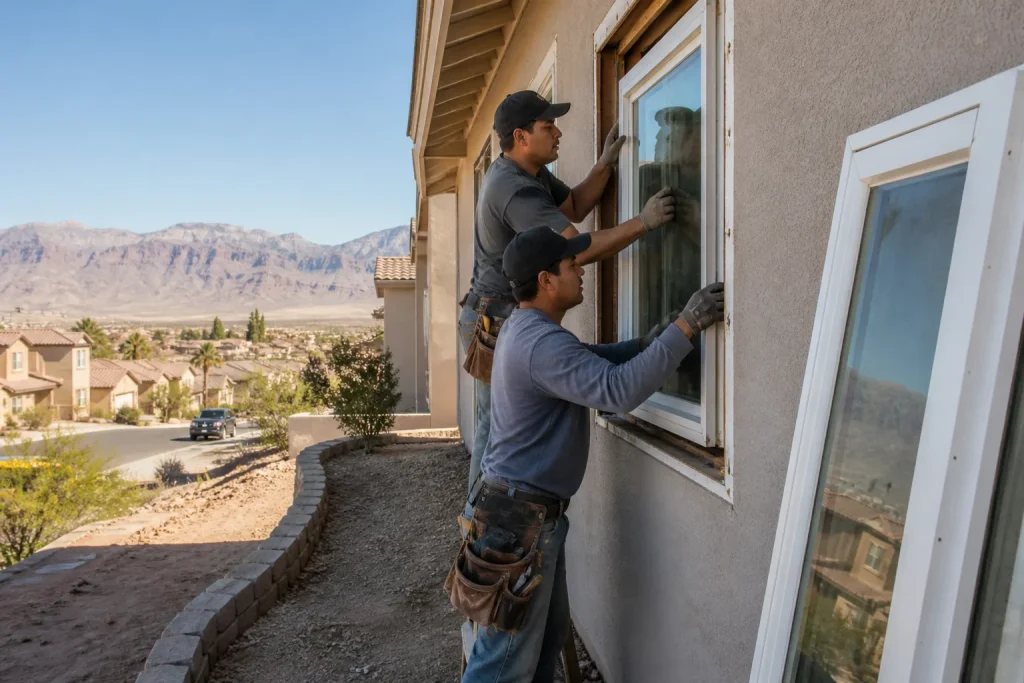
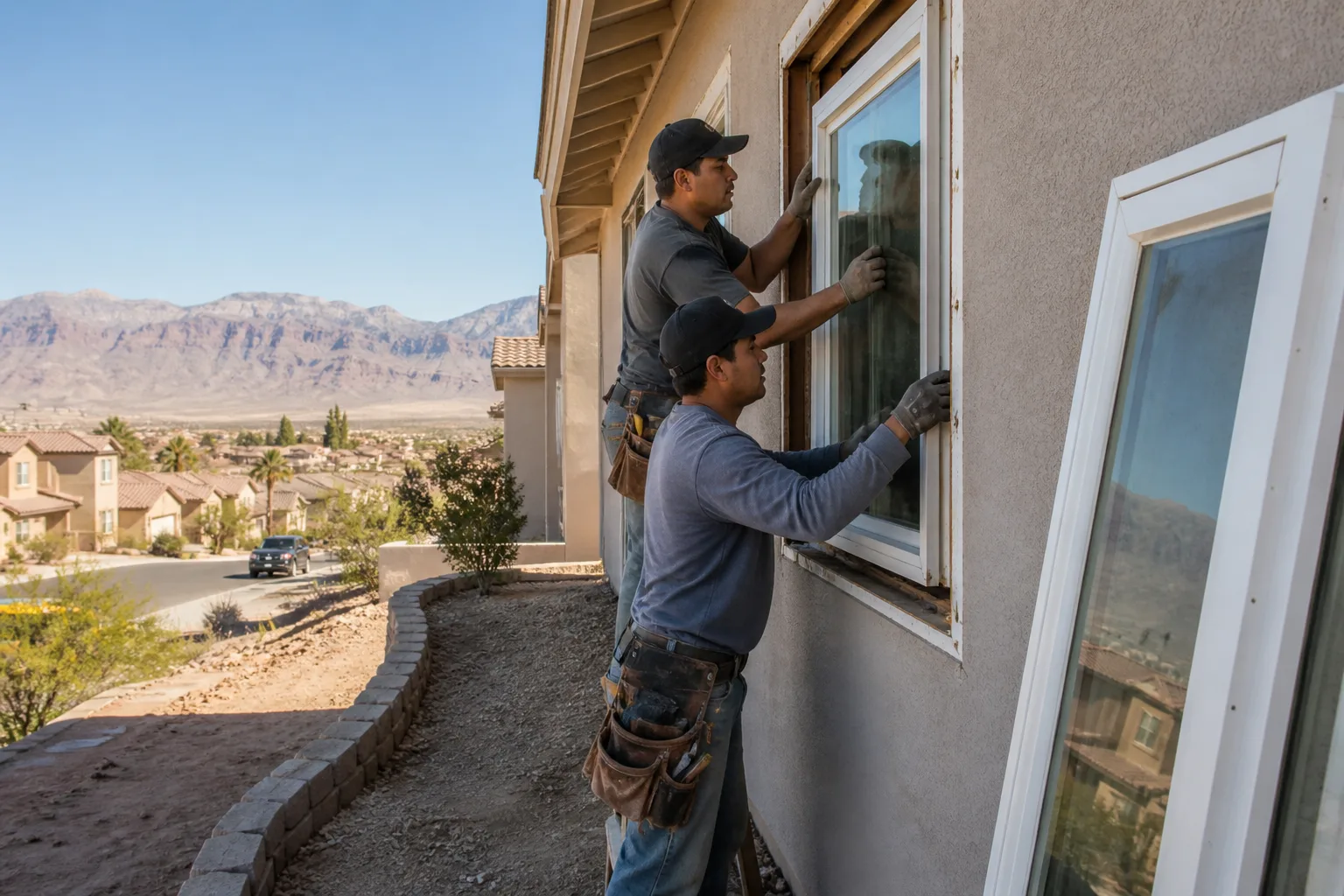
5 Mistakes to Avoid With Window Installation
The most expensive window installation mistake in Boulder City isn’t a botched install off a ladder. It’s signing a contract with the word “allowance” printed next to stucco repair, which quietly turns a fixed-price job into an open-ended one the moment the siding comes off. Four of the five costliest errors we see happen before a single tool gets lifted: in the measurement, the specification, and the paperwork. The install itself is the easy part to grade. The quote is where Boulder City homeowners actually lose money.
Here are the five, in the order they usually bite you. If you’d rather have a written price in hand before you sign anything, call (833) 847-4018 and we’ll review your estimate at no charge.
Key Takeaways
- Measure the daylight opening, not the old frame’s label. A 1/4-inch miss on a stucco home means custom fabrication: 3 to 4 extra weeks and $150 to $300 per unit.
- Never accept an open allowance for stucco or exterior trim. Demand a fixed line item with a per-linear-foot price.
- Egress window replacements and any change in opening size require a Clark County permit. Skipping it costs more on re-inspection than the permit itself.
- In Boulder City’s cooling-dominated climate, Solar Heat Gain Coefficient (SHGC) matters more than the U-factor printed on the NFRC label.
- A verbal walkthrough is not a scope document. Fastener type, flashing detail, and disposal need to be in writing.
Mistake 1: Ordering to the Old Frame’s Nominal Size Instead of Measuring the Daylight Opening
The daylight opening is the clear glass area you actually see through, measured to the framing members that hold the sash, not the rough opening behind the drywall and not the number printed on the old window’s spacer. Replacement units are ordered to the daylight opening, and this is where measurement errors get expensive fast.
Order a replacement window to the old frame’s nominal size and you inherit whoever installed the original’s rounding. On most construction, a small gap gets shimmed and sealed and nobody’s the wiser. On a stucco home, there’s no forgiving trim to hide behind. A 1/4-inch error forces custom fabrication, which in our experience adds 3 to 4 weeks to the lead time and $150 to $300 per unit on top of the price you budgeted. Multiply that by eight windows and you’ve paid for a small vacation you didn’t take.
We pulled a set of three sliders out of a garage near the old railroad cottages in Boulder City last year where the previous installer had measured to the trim, not the opening. The homeowner had already paid for two incorrect custom units before we arrived. The measured survey is the document that prevents this. Ask any installer to show you the sightline measurements in writing before you sign. If the numbers aren’t on paper, the price is a guess.
Mistake 2: Signing a Contract With an Open Allowance for Stucco Repair or Exterior Trim
This is the one that hurts Boulder City homeowners most, because so many homes here are stucco over frame. An allowance is a placeholder dollar figure. “Includes up to $500 allowance for stucco repair” sounds generous on page one and turns into a change order on page four, once the old window comes out and reveals what’s actually behind the wall.
A correctly written fixed-price line item looks like this instead:
- Stucco repair, per linear foot: a stated price per foot, with the linear footage measured from the survey and written into the quote.
- Exterior trim, per unit: the trim material named (wood, PVC, aluminum), with a fixed price for the affected openings.
- What’s excluded and why: any condition that genuinely can’t be priced without demo (say, hidden rot or water damage) should be named as a contingency with a separate written price, agreed before work proceeds.
- No change orders without written approval: the contract states plainly that any surprise gets a written price and your signature before the work continues.
Fixed pricing is the whole point. Haven Clause 1, “Have it in writing,” means the price on the survey is the price on the final invoice. If your quote has the word “allowance” anywhere near stucco, ask for a real number before you sign.
Mistake 3: Skipping the Clark County Permit on Jobs That Legally Require One
Not every window replacement in Boulder City needs a permit. A like-for-like swap that keeps the same opening size and same egress configuration usually doesn’t. But two job types legally require one: any egress window replacement (bedrooms and other sleeping rooms need a code-compliant egress path, and a replacement has to preserve that), and any change to the opening size, whether you’re enlarging or shrinking it. Structural implications aside, the inspector wants to see the opening matches the approved plan.
Skipping the permit is a false economy. When a re-inspection is needed because the original wasn’t pulled, the fine structure and re-inspection costs almost always exceed the permit fee you tried to avoid. Worse, when you go to sell the house and the county’s records show a window that was never permitted, the buyer’s agent flags it and you’re paying twice for a problem that should never have existed.
Ask a simple question when you get a quote: “Are you pulling a permit for this, and is the permit fee in the written price?” If the answer is “you don’t need one” on an egress window or a size change, that’s your sign to walk.
Mistake 4: Choosing a Window by U-Factor Without Checking SHGC
Homeowners are trained to look at the NFRC label and pick the lowest U-factor, because U-factor measures how well a window resists heat transfer and lower numbers are “better.” That’s true in Minneapolis. In Boulder City, it’s the wrong number to obsess over. The number that governs comfort and energy cost here is the Solar Heat Gain Coefficient (SHGC), which measures how much of the sun’s heat actually passes through the glass and warms the room inside.
Boulder City sits in a cooling-dominated climate. Summer sun is relentless and the air conditioner runs hard. A window with a great U-factor and a high SHGC lets more radiant heat in every afternoon, and the AC pays for it. In a cooling-dominated climate, you want a lower SHGC on the sun-facing exposures, especially on west and south glass, while a somewhat higher U-factor is less of a penalty than it would be up north.
The product lines we carry from PGT, CGI, CWS, and ES Windows each list their U-factor and SHGC on the specification sheet, and we specify them by what the opening requires, not by what’s in stock. On a west-facing great room in Boulder City, the SHGC target matters more than a U-factor that’s 0.02 lower on paper. Ask your installer to show you both numbers per exposure before you settle on a line, and to write them into the quote.
Mistake 5: Accepting a Verbal Walkthrough as a Scope Document
A verbal walkthrough feels reassuring because it’s a human who knows windows telling you what they’ll do. It’s also the least enforceable thing you can accept. The scope document is what governs the job if anything goes wrong, and here’s the specific written items that need to be in it:
- Fastener type and length: “screws” isn’t a specification. The fastener type and length need to be stated for the frame material.
- Flashing detail: how the opening gets waterproofed, and the product used to do it.
- Disposal included or excluded: hauling the old units away and disposal fees, written down.
- Interior and exterior finish-out: the trim, caulk, and patch work that’s included, and what the customer handles.
- The measured survey and the written scope: one document the customer keeps, so the price on the survey can’t differ from the price on the invoice.
A documented photo record on every visit closes the loop: before, during, and after, so evidence travels with the job. If an installer won’t put these items in writing, they’re asking you to trust them with your money and your home on the strength of a conversation.
When to Call a Pro
Most of these mistakes get spotted in the quoting phase, which is exactly when a second set of eyes costs nothing and saves a lot. If you’ve got a quote in front of you and you’re not sure whether the measurement is to the daylight opening, whether the stucco is fixed-priced or on allowance, or whether the SHGC was even checked, that’s the moment to ask. Our technicians have up to 14 years of experience reading these documents, and the 365-Day Done Right Promise means the job is only finished when it’s done right.
Related services in Boulder City: if you’re weighing a full replacement, start with Window Replacement in Boulder City. If your project includes a door alongside windows, see Door Installation in Boulder City, and for new construction or an addition, Window Installation in Boulder City. To compare our approach to the rest of our offering, visit the Sightline Windows & Doors Boulder City home.
The Bottom Line
The install crew gets blamed for mistakes that were made in the office. Measure the daylight opening. Fix the stucco price. Pull the permit on egress and size changes. Check the SHGC, not just the U-factor. And get the walkthrough in writing. Do those five things and you’ve eliminated the four out of five mistakes that quietly cost Boulder City homeowners the most.
If you’re in Boulder City and need help, Sightline Windows & Doors Boulder City offers free estimates – call (833) 847-4018 to schedule yours, or bring us a competitor’s written estimate for a free second opinion. Every engagement starts with a measured survey you keep, and the quote can’t differ from that document. No surprises.
Frequently Asked Questions
A measurement error on a stucco home runs $150 to $300 per unit in custom fabrication plus 3 to 4 weeks of lead time. An unpriced stucco allowance can add anywhere from a few hundred to several thousand dollars, depending on what’s behind the wall. The fix is almost always more expensive than doing it right the first time. Call (833) 847-4018 for a written price before you sign anything.
Yes if it’s an egress window replacement or you’re changing the opening size. A like-for-like swap at the same size and egress configuration usually doesn’t require one. Re-inspection costs and fines for an unpermitted job typically exceed the permit fee, and an unpermitted window can flag during a home sale. Call (833) 847-4018 to confirm what your specific job requires.
U-factor measures how well a window resists heat transfer; SHGC measures how much of the sun’s heat passes through the glass and warms the room. In Boulder City’s cooling-dominated climate, SHGC matters more on sun-facing exposures because it directly affects how hard the air conditioner works. Ask for both numbers per exposure, written into your quote. Call (833) 847-4018 if you’d like help reading the spec sheet.
Rarely. If the unit was ordered to the wrong size, it has to be re-measured, re-ordered, and re-installed, and on a stucco home that means repairing the opening too. If the flashing detail was wrong, water intrusion has usually already started and needs professional assessment before it spreads. This is work for a trained installer. Call (833) 847-4018 for a free estimate on getting it corrected.
Written by the team at Sightline Windows & Doors Boulder City.
Need Windows & Doors Help?
Call Sightline Windows & Doors Boulder City - licensed & insured, here with fast after-hours help in Boulder City.
(833) 847-4018