
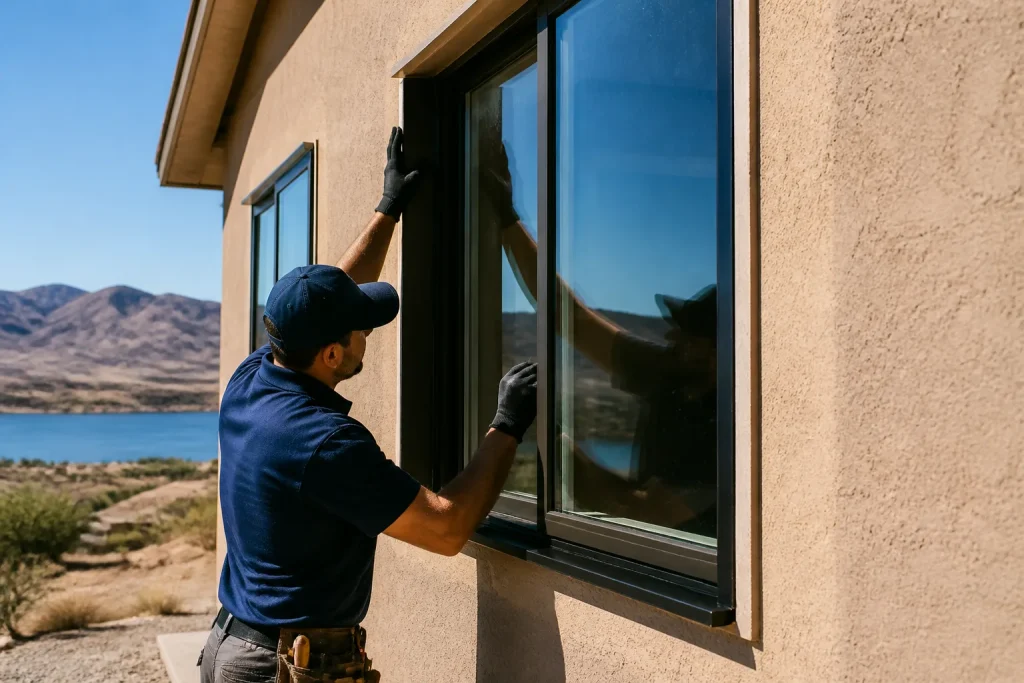
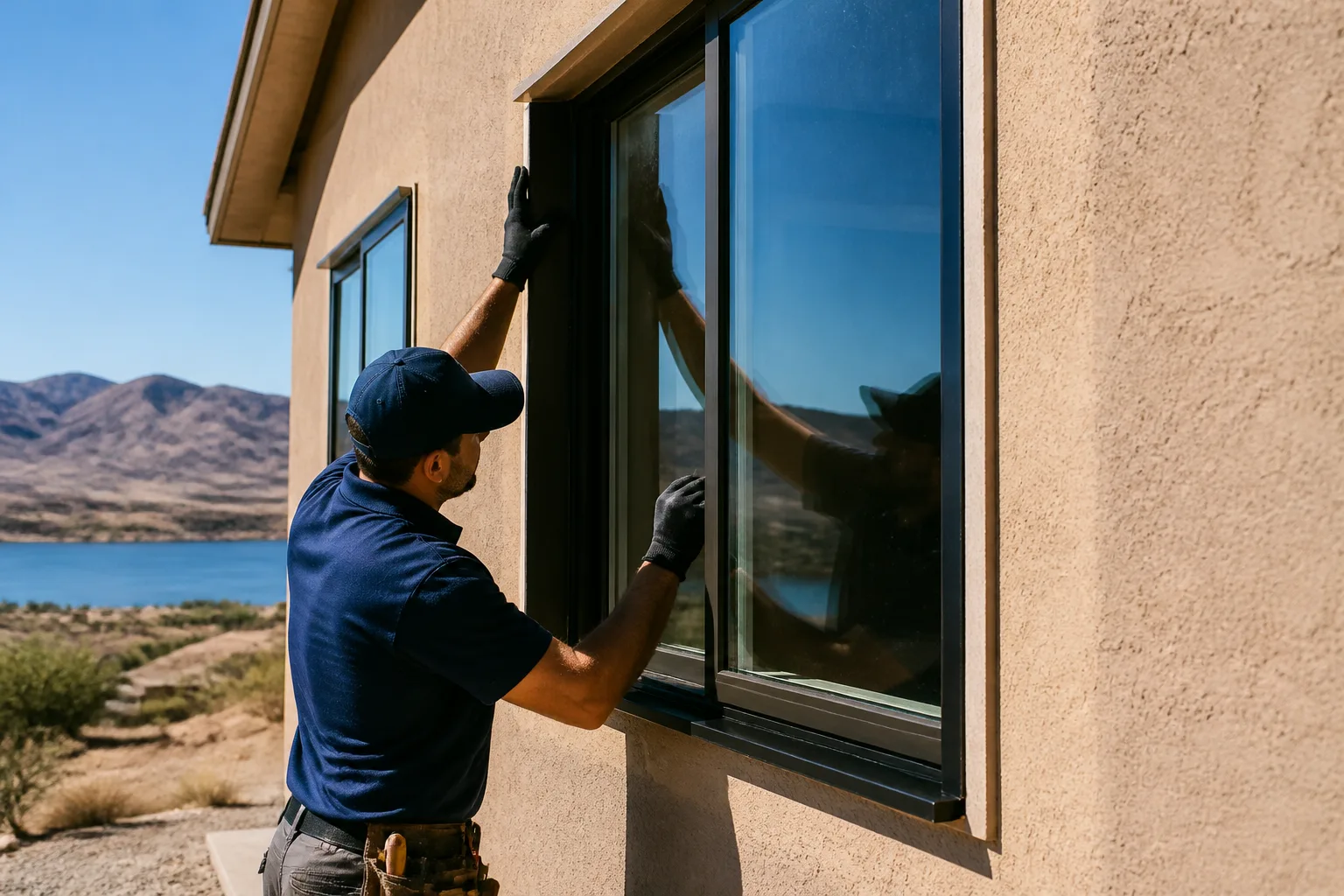
CWS Window Installation in Boulder City: A Homeowner’s Guide
About 60% of Boulder City’s housing went up before 1990, when rough opening standards were all over the map. That inconsistency is exactly where CWS windows earn their keep. Their thermally broken aluminum frames are custom-fabricated to your actual opening dimensions, not to a blueprint guess. But custom fabrication only helps if the installer measures the field correctly before submitting the order. Get that wrong and you’ve paid custom prices for a standard headache.
This guide covers what that custom capability actually costs in dollars and lead time, so you can compare CWS bids side by side instead of squinting at vague line items. If you’d rather have a written number in front of you than a range on a blog, call (833) 847-4018 and we’ll set up a free estimate.
Key Takeaways
- CWS is a thermally broken aluminum line built to custom dimensions, which fits Boulder City’s pre-1990 housing stock better than stock-size units.
- Expect roughly 6 to 12 weeks from order to delivery on custom CWS units, versus 2 to 4 weeks on standard sizes.
- Two independent field measurements before submission are standard practice, not overkill.
- Anodized finishes generally outlast painted finishes under Boulder City’s UV load.
- Your post-install photo record is the evidence a CWS warranty claim leans on.
What Is a Thermal Break, and Why Does It Matter in Boulder City?
A thermal break is a non-conductive barrier, usually polyamide or polyurethane, set between the inner and outer faces of an aluminum frame. Aluminum is a superb conductor, which is great for a frying pan and terrible for a window frame. Without a break, the frame itself becomes a bridge that moves heat straight through. With one, the frame stops conducting and the window’s U-factor drops accordingly.
Here’s the part that matters for Boulder City specifically. Our cooling loads dominate our heating loads by a wide margin. We’re running air conditioning from May into October, and the sun hits south- and west-facing glass hard all afternoon. A thermal break earns its money mostly on the cooling side here: it keeps the frame from radiating absorbed heat inward and keeps the interior surface closer to room temperature, which cuts condensation during the shoulder months. In a heating-dominated climate the same feature matters for the opposite reason. Same physics, different season driving the math.
When you’re comparing bids, ask for the whole-unit U-factor and the SHGC, not just the glass package. Solar heat gain coefficient tells you how much solar heat the assembly lets through, and in Boulder City that number does more work for your summer comfort than the U-factor alone. A window sold on glass specs alone can still underperform if the frame isn’t broken.
CWS sits in a useful tier here: thermally broken aluminum at a price point below the premium impact lines like PGT or ES Windows, but with far more sizing flexibility than an off-the-shelf unit. If you want to see how that tier compares across the whole category, our Window Replacement in Boulder City page lays out the options by performance and budget.
Custom vs. Standard Sizing: Lead Time and Cost in Clark County
This is where most CWS bids live or die. Custom sizing buys you a window that fits the opening you actually have. It also buys you a longer schedule, and homeowners routinely underestimate that gap when they’re penciling out a project.
| Factor | Standard Size | Custom CWS Unit |
|---|---|---|
| Typical per-unit price (installed) | $550 – $1,100 | $850 – $1,900 |
| Order-to-delivery lead time | 2 – 4 weeks | 6 – 12 weeks |
| Minimum order dimensions | Fixed catalog sizes | Roughly 12 in. width, 12 in. height |
| Fit to pre-1990 rough openings | Requires framing adjustments | Fabricated to field dimensions |
| Change-order risk | Higher on odd openings | Lower when measured correctly |
Those installed ranges reflect the Boulder City market and vary with glazing package, finish, and how many units you’re ordering at once. The lead time is the honest scheduling constraint: a custom CWS order placed in early spring may not land until early summer. That’s not a reason to avoid custom sizing. It is a reason to lock measurements and place the order before you’ve scheduled anything else.
In our experience, the standard-versus-custom decision often comes down to how many openings in the house are actually odd-sized. One or two odd windows in an otherwise standard house is a different conversation than a 1960s ranch where nothing matches anything. We’ve walked plenty of Boulder City homes where the difference between the living room window and the bedroom window was just a builder’s mood that day.
The Field Measurement Process CWS Requires Before Order Submission
CWS won’t fabricate from blueprint dimensions, and that’s a feature, not a hurdle. Plans describe what was supposed to be built. Field measurements describe what’s actually there. In a city where the housing stock skews pre-1990, those two documents diverge more often than anyone would like.
Two independent measurements before submission are standard practice for good reason. Here’s what that process looks like in sequence:
- 1
Initial field measure. Width and height taken at three points per opening (top, middle, bottom for width; left, center, right for height), and the smallest reading governs the order.
- 2
Square and level check. A racked or out-of-level opening will bind a square window. This check determines whether the opening needs correction before the unit arrives.
- 3
Sightline and depth measurement. How the window sits in the wall affects the exterior reveal and the interior trim, and it has to be decided before fabrication.
- 4
Second independent measurement. A different set of hands, same openings, compared against the first. Discrepancies get resolved before the order goes in, not after the units land on the driveway.
The cost of skipping step four is a custom window that doesn’t fit and a 6-to-12-week clock that restarts. That’s the single most expensive mistake we see on CWS projects, and it’s entirely preventable. Whether you’re working with us or another Clark County installer, ask directly whether two independent measurements are part of the process. If the answer is vague, that tells you something.
Anodized vs. Painted Finishes Under Boulder City’s UV Load
Boulder City sits at roughly 4,000 feet with a UV index that spends much of the year in the high to very high range. That’s not a cosmetic detail. It’s the main variable in how long a window finish lasts.
- Anodized finish. The aluminum surface is electrochemically converted into an integral oxide layer, not coated. It doesn’t chip or peel because there’s no film to fail. Under our UV conditions, expect a service life in the range of 20 to 30 years before any meaningful fading or chalkiness.
- Painted finish. A factory-applied paint or powder coat over the aluminum. Attractive, available in more colors, and generally good for 10 to 15 years in Boulder City before fading, chalking, or edge wear starts showing, especially on south- and west-facing elevations.
The tradeoff is straightforward. Anodized lasts longer and shrugs off UV, but the color options are limited to metallic tones. Painted gives you real color choice at a shorter service life. On a west-facing wall in Boulder City, that difference is not theoretical; we’ve seen painted frames on the sun side of a house look tired years before the same finish on the shaded side.
Both finishes carry a cost difference worth asking about up front, usually in the range of $40 to $90 per unit on a CWS order depending on color and quantity. If you’re undecided, the rule we suggest is simple: shaded elevations and color-critical facades get paint, sun-blasted exposures get anodized.
What the Photo Record Should Document After Install
A CWS warranty claim lives or dies on documentation. The manufacturer will want evidence of how the unit was installed, and a photo record assembled after the fact is worth very little. The record has to be built during the install, opening by opening.
Here’s what a complete post-install record should show:
- Pre-install opening condition. The rough opening after the old unit is out, showing framing, sill, and any water damage or rot.
- Flashing and sealant detail. The water-management layer at the sill and jambs, before the unit is set. This is the single most-warranty-relevant photo in the set.
- Shim and fastener placement. How the unit was leveled and anchored, visible before trim goes on.
- Completed unit, interior and exterior. Both sides, showing the finished reveal and sealant lines.
- Label and serial photos. The CWS label on the glass or frame, so the unit can be identified by the manufacturer without argument.
Ask any installer whether you’ll receive a documented photo record at the end of the job. If they hesitate, that’s your answer. We build the photo record into every visit as standard evidence, not an upsell, because a warranty claim you can’t support with photos is a warranty claim you don’t win.
When to Call a Pro
Some window work is genuinely a homeowner job. Replacing weatherstripping, re-caulking a failing exterior seal, adjusting a sticky sash. When it comes to a CWS install, though, the point of no safe return is the measurement and the flashing. Getting either wrong puts you into a custom-order delay or a water-intrusion problem, and both are expensive to unwind. If you’re looking at a pre-1990 opening that isn’t square, or you’re comparing multiple CWS bids and can’t tell where the numbers diverge, that’s when to bring in a pro.
Related services in Boulder City: If your project also includes an entry or patio door opening, see our Door Installation in Boulder City page, or review the full scope on Window Installation in Boulder City. For the bigger picture on what we do, start at the Sightline Windows & Doors Boulder City home.
The Bottom Line
CWS windows sit in a real, useful tier: thermally broken aluminum frames, custom-fabricated to your actual opening dimensions, at a price below the premium impact lines and with more flexibility than anything off the shelf. In Boulder City’s pre-1990 housing stock, that flexibility matters. But the value of a CWS unit is only as good as the field measurement behind it and the photo record in front of it.
Compare bids on four numbers: the whole-unit U-factor and SHGC, the finish type and expected service life, the order-to-delivery lead time, and whether two independent field measurements are included. Get those four answers in writing and the bids stop looking alike.
If you’re comparing CWS against other lines like PGT, CGI, or ES Windows and want a second set of eyes on the estimates in front of you, bring us a competitor’s quote and we’ll review it at no charge. If you’re in Boulder City and need help, Sightline Windows & Doors Boulder City offers free estimates. Call (833) 847-4018 to schedule yours. You’ll get a written price before any work starts, a measured survey you keep, and a photo record when the job is done.
Frequently Asked Questions
Most CWS window installations in Boulder City run $850 to $1,900 per unit installed, depending on size, glazing package, and finish. Standard-size units run less at $550 to $1,100. Custom sizing, anodized finishes, and low-SHGC glazing push toward the top of the range. Call (833) 847-4018 for an exact quote, which we’ll put in writing before any work starts.
Expect 6 to 12 weeks from order submission to delivery for custom CWS units in Clark County. Standard sizes arrive faster at 2 to 4 weeks. The custom timeline is driven by fabrication, and it’s the main scheduling constraint on a Boulder City project. Ask (833) 847-4018 for a current lead time before you commit to a start date.
Yes, and that’s the main reason homeowners in Boulder City consider CWS. Roughly 60% of the city’s housing was built before 1990, when rough opening standards were inconsistent. CWS’s custom fabrication lets the frame match the actual field-measured opening, so you avoid the framing adjustments a standard-size unit would require. Call (833) 847-4018 and we’ll measure before we quote.
CWS is not primarily an impact-rated line; that’s a question for PGT, CGI, or ES Windows depending on your opening. CWS excels at thermal performance and custom sizing in non-impact applications. If impact rating is a requirement on your project, say so up front. Call (833) 847-4018 and we’ll tell you honestly whether CWS fits or whether you need to look at a different line.
Written by the team at Sightline Windows & Doors Boulder City.
Need Windows & Doors Help?
Call Sightline Windows & Doors Boulder City - licensed & insured, here with fast after-hours help in Boulder City.
(833) 847-4018